

Related Articles
How Finalyse can help
PHYSICAL RISKS IMPACT MEASUREMENT
Climate-related physical risks, including floods, droughts, heatwaves and other extreme weather events are increasing in frequency and severity due to climate change. These hazards directly affect tangible assets, collateral values, supply chains and corporate financial performance.
Banks and financial institutions require robust, forward-looking methodologies to quantify these risks, assess their financial implications, and integrate them into credit risk parameters (PD, LGD, RWA). Our service enables institutions to translate hazard data into actionable risk metrics while ensuring regulatory alignment and methodological rigor.
How does Finalyse address your challenges?
Hazard Identification and Mapping
Identifying and mapping climate hazards, such as river floods and droughts, and geolocating assets to determine exposure levels
Financial Impact Analysis
Calibrating sector-specific impact functions to quantify the relationship between hazard intensities and resulting physical or economic damages
Credit Risk Parameter Integration
Integrating climate shocks into credit risk parameters by adjusting collateral values and counterparty financials to estimate shadow PD, LGD, and RWA
Advanced Scenario Modelling
Performing forward-looking stress tests and simulations under various climate scenarios (e.g., RCP pathways) across different time horizons
Methodology and Compliance
Developing frameworks that align with central bank and supervisor expectations, utilizing IPCC-based projections and CMIP data
Workshops
Conducting expert-led workshops on physical risk analysis, covering everything from data sourcing to credit model integration.
How does it work in practice?
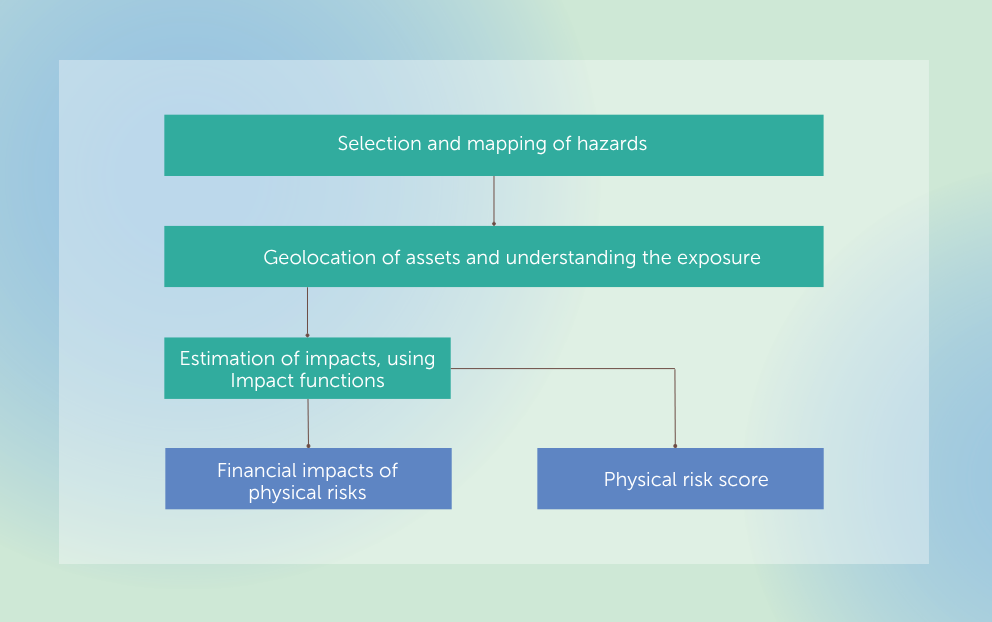
Physical risk integration requires more than hazard mapping, it demands a structured translation of climate data into financial risk metrics. Finalyse has developed a robust framework to translate climate hazard intensities into financial shocks. Our methodology follows a structured path:
Portfolio & Hazard Scoping: We identify material hazards (e.g. river floods, droughts) across relevant geographies and determine exposure concentration at counterparty and collateral level.
Data Collection & Geospatial Mapping: We map physical assets, collateral locations and sector exposures against forward-looking climate projections and return-period evolution.
Impact Function Calibration: Sector and asset specific damage functions are sourced from academic literature and supervisory publications, then calibrated to reflect portfolio characteristics.
Financial Transmission Channels: We quantify, direct damages to physical assets, Collateral value reductions, Revenue and production shocks (e.g. agriculture, hydropower) and Business interruption effects. These impacts are then translated into financial statement stress.
Credit Risk Parameter Adjustment: We integrate physical risk into credit models using:
Collateral haircuts and LTV shocks
LGD adjustments based on expected damage
PD scaling factors driven by changing hazard probabilities
Structural modelling approaches (Merton/Vasicek with jumps)
Simulation based methodologies for tail risk estimation
Portfolio & Capital Impact Assessment: We assess:
RWA impacts
Expected loss and capital impact
Scenario comparisons (baseline vs climate-adjusted)
Governance & Model Risk Considerations: Given reliance on forward-looking projections and impact functions, we ensure transparent documentation, sensitivity analysis and model risk governance.

Managing Consultant
Expert Climate Risk
Key Features
- Finalyse offers extensive experience and expertise in area of ESG and climate related assessment for financial institutions.
- Finalyse delivers an end-to-end physical risk assessment framework, covering hazard identification, exposure mapping, vulnerability analysis and financial impact quantification within a coherent and structured methodology.
- Physical climate impacts are translated into actionable credit risk metrics, including PD, LGD, LTV and RWA adjustments, ensuring direct integration into existing credit risk frameworks
- Benefit from Finalyse’s unique approach, tailored to the specific needs and circumstances of each financial institution.
- Long Term Sustainability: Advanced modelling techniques, including structural credit risk models and simulation-based approaches, allow institutions to capture severe but plausible events while maintaining strong governance and regulatory alignment.
Alexandre Synadino is a managing consultant with expertise in risk data analytics, climate risk management and regulatory reporting. He is an active member of the Finalyse Climate Risk Centre. His main area of expertise lies in the research, design and development of physical risk assessments using different tools and methods. Alexandre is involved in the conceptualisation of measurement approaches to cover multiple hazard types, geographies and scenarios to respond to regulatory demands for granular and forward-looking analyses.


David Boavida is a senior consultant with extensive experience in modelling and managing Market and Liquidity Risk and a solid foundation in Asset and Liability Management (ALM). In particular, his main areas of expertise lie within IRRBB & CSRBB. His technical skills cover a range of multi-purpose programming languages, including Python, R and MATLAB. David also has comprehensive knowledge and experience in Basel III Regulatory Reporting, Liquidity and Funding Risks and Stress Testing.