


Alana Mackle is a Senior Consultant with over five years of international experience across (re)insurance and consulting. Her expertise spans pricing, reserving, and actuarial modelling, supported by a strong ability to translate complex technical findings into clear, decision-ready insights for senior stakeholders. She has extensive experience delivering Solvency II and IFRS 17 work, with proven capability in model development, validation, and regulatory reporting.
Insurance and financial services are evolving faster than many internal teams can keep up with. Despite frequent talk of resilience, many functions remain one resignation, one review cycle, or one regulatory letter away from a serious capability gap. Solvency II and IFRS 17 continue to challenge insurers, model risk expectations are rising, climate-related work is accelerating, and regulators are demanding deeper challenge and stronger governance.
The Individual Accountability Framework (IAF) and Senior Executive Accountability Framework (SEAR) add further pressure by placing accountability on senior leaders and requiring credible contingency plans for key-person risk. Picture the scenario: a senior actuary resigns weeks before year-end with a six-month hiring lead time, or a full-time risk manager is recruited at great expense to remediate regulatory issues only to become underutilised once the project is complete.
Most in-house teams lack the capacity or technical depth to meet the demands of today’s environment - and regulators know it. Co-sourcing is no longer a “nice to have”; it has become the go-to operating model for preserving ownership and governance while adding targeted expertise and scalable capacity where it matters most.
Let’s be clear: co-sourcing isn’t about offloading work. It’s the opposite. It’s about reinforcing the control framework while keeping:
Traditional outsourcing can create distance, loss of context, and regulatory risk. Co-sourcing overcomes this by embedding expertise, providing on-demand technical depth, and delivering independent challenge - meeting Solvency II expectations. Regulators don’t want outsourced functions; they want well-resourced ones. Co-sourcing bridges that gap.
Inspections, thematic reviews, and supervisory letters are hammering the same themes:
Co-sourcing helps insurers demonstrate what supervisors want to see: credible resourcing, independent challenge, and sustainable delivery - not heroics from the same two people every quarter-end.
Across the core control functions, particularly actuarial and risk teams, insurers face a structural talent challenge that the market isn’t resolving.
Recruitment cycles are long, specialist skills are increasingly niche, and retention rates are declining. Workforce expectations have also shifted: hybrid working is now mandatory for many, experienced specialists prefer portfolio careers, and younger professionals prioritise flexibility and balance over traditional corporate roles.
Co-sourcing fills this gap by providing scalable, on-demand expertise - including specialists who would be impractical or too costly to hire permanently - multiplying internal capability without adding permanent headcount.
Full outsourcing - common in actuarial and internal audit - can create over reliance on external providers. The excessive dependency can leave firm’s unable to run a competitive tender process when fees inevitably rise. Co-sourcing avoids this by keeping the power balance in check.
A co-sourced model ensures:
The result is a more resilient, transparent, and sustainable operating model.
The Solvency II control functions continue to see strong uptake of hybrid delivery models:
Across these functions, co-sourcing provides independent challenge, specialist capability, and insight into evolving market practice.
Co-sourcing delivers value when implemented correctly - but it is not a silver bullet. Issues arise when roles are unclear, knowledge becomes concentrated with external teams, documentation fragments, or independence requirements are misunderstood, particularly in risk and internal audit. The most common pitfall is internal oversight slipping due to overreliance and overfamiliarity with co-sourced providers who are assumed to handle everything.
These issues are preventable. Clear governance, defined ownership, and structured knowledge documentation ensure that co-sourcing strengthens internal capability. Success requires active management, with accountability and oversight firmly retained within the organisation.
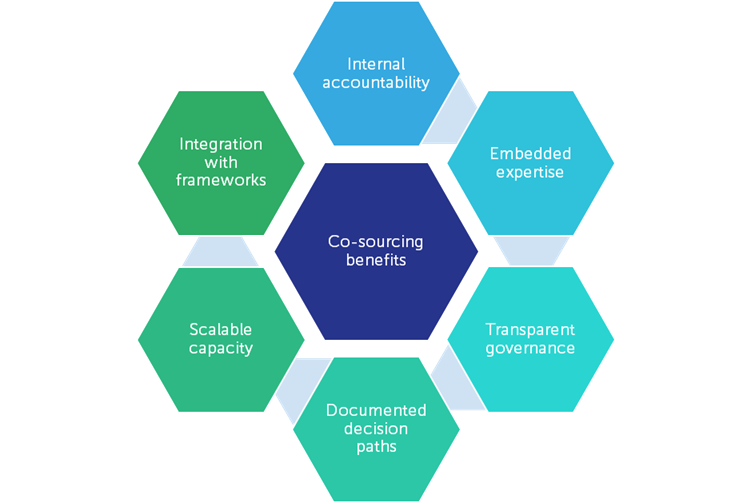
Strong co-sourcing models maintain internal accountability, embed external expertise where it adds most value, ensure transparent governance, document decision paths, and scale capacity with business cycles. Smooth integration with existing controls ensures continuity even when existing control frameworks, ensuring continuity even when key personnel leave.
Beyond the compliance assurance, co-sourced solutions can provide flexibility to manage workload, reduce reliance on permanent headcount, and give access to specialist skills that would be costly or impossible to hire full-time. Cost efficiency follows naturally, but the primary goal remains strengthening internal capability and operational resilience.
Rising regulatory, risk, and reporting expectations require operating models that deliver resilience without compromising oversight. Co-sourcing reinforces internal teams with specialist expertise, independent challenge, and market insight, providing a sustainable, well-governed, and cost-effective way to maintain technical depth and operational continuity.
Finalyse helps insurers translate this hybrid approach into practical solutions. Examples include:
By embedding expertise, maintaining internal ownership, and offering flexible, scalable capacity, Finalyse enables insurers to meet regulatory expectations, manage market and operational shocks, and strengthen the resilience of their control functions.
Co-sourcing reinforces internal control functions by embedding expert support while keeping authority, accountability, and knowledge inside the organization. Unlike outsourcing - which can create distance, dependency, and regulatory risk - co-sourcing maintains internal ownership and governance while adding targeted, on-demand expertise.
Actuarial, Risk Management, Compliance, and Internal Audit functions see the strongest impact. Co-sourcing enhances areas such as ORSA, model validation, assumption reviews, scenario design, regulatory horizon scanning, and specialist audit topics.
Co-sourcing provides scalable capacity, specialist skills, and independent challenge without adding permanent headcount. It ensures continuity during staff turnover, addresses capability gaps, and enhances credibility with regulators - resulting in a more resilient, well-governed operating model.
Finalyse InsuranceFinalyse offers specialized consulting for insurance and pension sectors, focusing on risk management, actuarial modeling, and regulatory compliance. Their services include Solvency II support, IFRS 17 implementation, and climate risk assessments, ensuring robust frameworks and regulatory alignment for institutions. |

Check out Finalyse Insurance services list that could help your business.
Get to know the people behind our services, feel free to ask them any questions.
Read Finalyse client cases regarding our insurance service offer.
Read Finalyse blog articles regarding our insurance service offer.
Designed to meet regulatory and strategic requirements of the Actuarial and Risk department
Designed to meet regulatory and strategic requirements of the Actuarial and Risk department.
Designed to provide cost-efficient and independent assurance to insurance and reinsurance undertakings
Finalyse BankingFinalyse leverages 35+ years of banking expertise to guide you through regulatory challenges with tailored risk solutions. |

Designed to help your Risk Management (Validation/AI Team) department in complying with EU AI Act regulatory requirements
A tool for banks to validate the implementation of RWA calculations and be better prepared for CRR3 in 2025
In 2027, FRTB will become the European norm for Pillar I market risk. Enhanced reporting requirements will also kick in at the start of the year. Are you on track?
Finalyse ValuationValuing complex products is both costly and demanding, requiring quality data, advanced models, and expert support. Finalyse Valuation Services are tailored to client needs, ensuring transparency and ongoing collaboration. Our experts analyse and reconcile counterparty prices to explain and document any differences. |
Helping clients to reconcile price disputes
Save time reviewing the reports instead of producing them yourself
Helping institutions to cope with reporting-related requirements
Be confident about your derivative values with holistic market data at hand
Finalyse PublicationsDiscover Finalyse writings, written for you by our experienced consultants, read whitepapers, our RegBrief and blog articles to stay ahead of the trends in the Banking, Insurance and Managed Services world |

Finalyse’s take on risk-mitigation techniques and the regulatory requirements that they address
A regularly updated catalogue of key financial policy changes, focusing on risk management, reporting, governance, accounting, and trading
Read Finalyse whitepapers and research materials on trending subjects
About FinalyseOur aim is to support our clients incorporating changes and innovations in valuation, risk and compliance. We share the ambition to contribute to a sustainable and resilient financial system. Facing these extraordinary challenges is what drives us every day. |
Finalyse CareersUnlock your potential with Finalyse: as risk management pioneers with over 35 years of experience, we provide advisory services and empower clients in making informed decisions. Our mission is to support them in adapting to changes and innovations, contributing to a sustainable and resilient financial system. |

Get to know our diverse and multicultural teams, committed to bring new ideas
We combine growing fintech expertise, ownership, and a passion for tailored solutions to make a real impact
Discover our three business lines and the expert teams delivering smart, reliable support