



Maël Kerbaul is a Senior Consultant with over 15 years of experience in the banking and financial industry, especially in risk management. His main area of expertise lies in the credit risk management and regulatory capital calculation. He has developed a broad knowledge of Basel IV/CRR3 while he played a major role in the impact assessment of this new regulation at a large financial institution in Belgium. Maël has also a wide experience in data analysis for credit risk and has a good command of SAS EG and SQL.
Responding to the Draghi, Noyer and Letta reports, EBA/ESMA analyses, and a 2024 Commission consultation, the European legislator is proposing reforms to revitalize its securitization market, which has remained subdued since the 2008 financial crisis due to stringent rules introduced under the 2017 Securitization Regulation (SECR) and related prudential requirements in the Capital Requirements Regulation (CRR). In June 2025, The European Commission (EC) published legislative proposals amending SECR (Regulation (EU) 2017/2402) and CRR (Regulation (EU) 575/2013). These aim to cut excessive administrative burdens, enhance proportionality, reduce operational friction, and render securitization more attractive for banks, investors, and the real economy—while preserving core protections like transparency, risk retention, due diligence, and financial stability.
Following the usual legislative train, the ECB gave its opinion on the proposal on 11 November 2025 (see [8]). A month later, ECON published its draft report, and the Council announced its final position. The Parliament adopted ECON’s draft report on May 5th after amendments from MEP’s. Both Council and Parliament bring overall support to the EC proposal but include major adjustments. This will be the basis for the Trilogue discussions kicking off in the second half of 2026.
The EC proposal differentiates between public (traded or prospectus-required) and private securitization, simplifies reporting and introduces risk-sensitive due diligence. The most significant change is the introduction of the resilient category of securitizations, which opens up avenues to further reduction of risk weight for the right kinds of safe and simple securitization.
ECB breaks the proposal of the EC down into 11 specific topics, of which it agreed or partially agreed with 6, including the most substantial change, the introduction of the resilient securitization.
The ECB disagreed with the proposed amendments to the risk weight floor and the P factor but offered an alternative change (treated in detail below). However, Council and Parliament follow the EC’s proposal with some adjustments to the parameters levels.
Finally, the ECB strongly disagreed with the amendments to the STS criteria, the revised definitions of public securitizations and of the senior securitization positions. The two latter have been rejected in Council and Parliament positions, while they are more supportive of the revisions to STS criteria.
See the table below for a breakdown of the ECB’s, Council’s and Parliament’s positions.
| Topic | ECB opinion | Council position | Parliament position |
| Simplification of investor due diligence requirements | Partially agree | Partially agree | Partially agree |
| Relaxation of certain risk retention requirements | Partially agree | Agrees | Agrees |
| Simplification of disclosure requirements | Agrees | Partially agree | Partially agree |
| Amendments to the STS criteria | Disagrees | Agrees with safeguards | Agrees |
| Amendments to the definition of public securitisation | Disagrees | Disagrees | Disagrees |
| Amendment to the definition of senior securitisation position | Disagrees | Disagrees | Disagrees |
| Introduction of the concept of a resilient position | Partially agree | Agrees | Partially agree |
| Amendment to the risk weight floors | Disagrees, proposes different change | Agrees with adjustments | Agrees with adjustments |
| Amendment to the p factor in the calculation of risk weights for securitisation positions | Disagrees, proposes different change | Agrees with adjustments | Agrees with adjustments |
| Amendments to the SRT criteria | Agrees | Agrees | Agrees |
| Amendments to the SRT process | Agrees | Agrees | Agrees |
Table 1: Summary of ECB opinion broken down by topic
We will treat the most significant changes proposed below, these are the proposed introduction of the resilient position, the changes to the P factor and the changes to the risk weight floor. We will briefly touch on the other changes.
The proposed changes to CRR Article 243 introduce the category of resilient securitization positions: senior positions which satisfy a set of eligibility criteria (low agency and model risk and loss absorbing capacity), with benefits to the risk weight floor and, for certain investor positions, to the P scaling factor, which directly impact the RWA requirement. The impacts of the resilient non resilient category are different depending on the role of the institution (with investors in senior positions profiting in particular), the STS or non-STS status of the exposure and the regulatory framework (SA, IRB or ERBA) of the securitization. We will treat the impact of the resilient framework before we discuss the definition of resilience.
The proposed framework allows for both STS resilient positions and non-STS resilient positions. The most common case will be for a resilient position to also comply with the STS requirements. For the STS resilient positions the risk weight floor will be lowered for originators, sponsors and investors, from 7% to 5%, regardless of the regulatory framework (IRB, SA or ERBA) applicable. Please note that for STS only, the floor is 7%, whereas for STS and resilient, the floor is 5%.

So what conditions actually qualify a position as resilient? For senior STS positions there is only 1 requirement in addition to the existing STS requirements, a minimum level of credit enhancement which is effectively a quantitative check on the attachment point. For SEC-SA or SEC-ERBA the following formula applies:
\(\displaystyle A \geq 1.5 \times K_a\)
where:
\(A\) = the attachment point;
\(K_a\) = defined in CRR Article 261 paragraph 2, it is the weighted average standardised capital charge of the underlying pool with an additional penalty for the fraction defaulted;
The minimum credit enhancement for SEC-IRBA is given by:
\(\displaystyle A \geq 1.1 \times (EL \times WAL + UL)\)
where:
\(A\) = the attachment point;
\(EL\) = the expected loss;
\(WAL\) = the weighted average life;
\(UL\) = the unexpected loss;
For non-STS resilient positions in addition to the quantitative criteria there are also some qualitative criteria to fulfil, found in the proposed article 243. We won’t treat these in detail.
The ECB proposes to completely scrap the non-STS resilient category and only allow STS positions to be resilient. The impact of resilient vs non resilient is also reduced: only for originators and sponsors in senior positions there will be a 2% reduction in the risk weight floor. So there is no reduction in the P factor for investors, nor a reduction in the risk weight floor for investors. The quirk in the proposed changes is that for investors in non-STS positions the resilient category does not matter at all.

The ECB supports the introduction of the new resilient category. By privileging the originator sponsor the agency risk is reduced, and therefore a reduction in risk weights is justified. The ECB suggests that the non-STS resilient category is removed, simplifying the framework somewhat and making resilient positions an “STS+” position. The ECB estimates that 60% of STS positions already meet the resilient criteria. This means that a significant amount of the current securitization positions will benefit from risk weight reductions as soon as the new regulation goes into effect.
The Council maintains the EC proposal for a new resilient category, for both STS and non-STS transactions. It removes the need for a continuous reassessment of the credit enhancement criterion. This criterion needs to be validated only at origination.
ECON criticizes the complexity of the resilient concept but agrees to keep it in order not to extend the delays of implementation. Parliament therefore proposes a simplification of the resilient concept and a reduction of the number of categories for calculating risk-weights. It considers the STS concept sufficient for traditional securitisations and proposes to treat all STS senior tranches of traditional securitisation as resilient, including investor positions.
As the Council, ECON also removes the need for a continuous reassessment of the credit enhancement criterion.
Will your senior positions qualify as resilient?
Our team can assess your current and planned transactions against the proposed criteria and estimate the capital impact under each institution’s position.
Explore our Securitisation and SRT support
The P factor is a key factor in the capital requirement for securitized positions. The EC proposal recalibrates the (p) factor in order to make it more advantageous to hold robust (STS or resilient) positions, or to have an originator position. It is a driver of the “capital non-neutrality” of securitizations. A (p) factor of 1 means that holding all tranches of a securitized pool would carry 100% more risk weight than holding the underlying pool directly. This additional risk weight is justified by the modelling and agency risks inherent to securitization.
The (p) factor is only relevant for the SEC-IRBA and SEC-SA frameworks, however the SEC-ERBA framework will be adjusted such that the level of capital requirements goes down in line with the reductions in the other frameworks. The SEC-IRBA (p) factor is calculated according to the following formula:
$$p = \min\left\{\mathrm{Cap},\ \max\left[\mathrm{Floor},\ \mathrm{SF} \times \left(A + B\left(\frac{1}{N}\right) + C \times K_{\mathrm{IRB}} + D \times \mathrm{LGD} + E \times \mathrm{MT}\right)\right]\right\}$$
where:
\(\mathrm{Cap}\) = newly introduced maximum \(p\) value, dependent on STS or non-STS, see Table 2;
\(\mathrm{Floor}\) = lower bound of the \(p\) factor, depending on the position, see Table 2;
\(\mathrm{SF}\) = scaling factor of the \(p\) factor, depending on the position, see Table 2;
\(A, B, C, D, E\) = parameters determined according to the lookup table in CRR Art. 259;
\(N\) = effective number of exposures, calculated in accordance with CRR Art. 259;
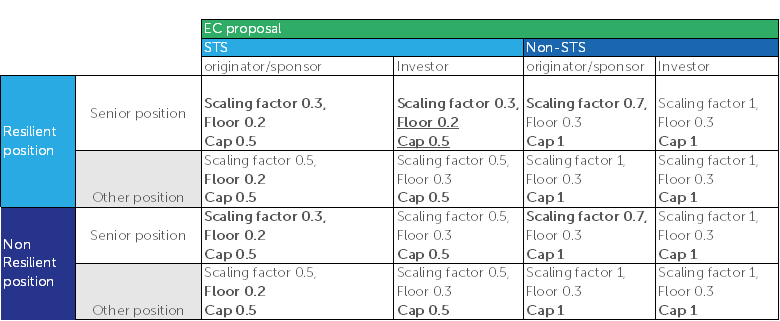
For the SEC-SA the new constants for the (p) parameter are collected in Table 3.

Since the introduction of the standardized risk weight floor, the importance of the (p) factor in SEC-SA is of particular importance. The currently applicable (p) factor is in fact lowered in the transitory arrangement for the output floor (CRR article 465) to 0.25 for STS positions and 0.5 for non-STS positions (from 0.5 and 1.0) respectively.
The ECB opinion sees the merit in adjusting the (p) factor for these cases specifically, and considers the adjustment of the (p) factor otherwise something that should flow from a new Basel accord.
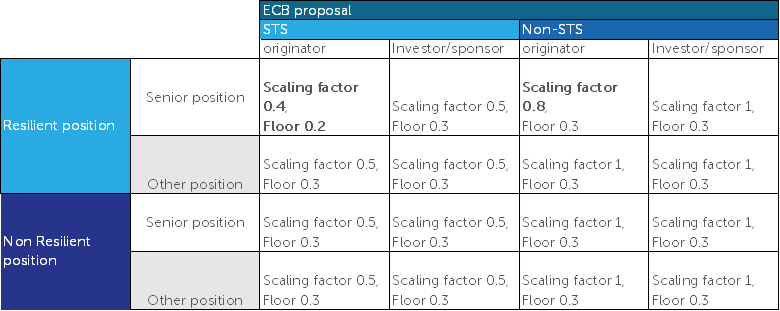
The ECB proposals (see Table 4, Table 5) are therefore less risk-sensitive and more conservative overall. Note that only the originator benefits in the ECB opinion and not both the originator and sponsor.
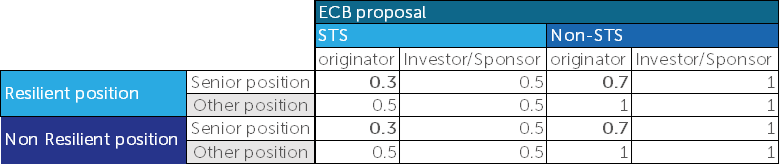
Similarly to ECB, the Council removes the cap for the p-factor under SEC-IRBA. It also aligns the treatment for STS positions for originator and investor positions, so that investors will also benefit from the reductions for senior positions.
Parliament retains the cap for the p-factor under SEC-IRBA but proposes reduced values compared to the EC proposal for senior positions. It also aligns the treatment for originator and investors for both STS and non-STS.
The EC proposes to make the risk weight floors more risk sensitive, and to lower them.
The current flat risk weight floors of 10% for STS and 15% for non-STS are replaced by new floors proportionate to the riskiness of the underlying exposures, based on KIRB or KA, and subject to minimum levels depending on the STS and resilient nature.
The ECB sees this proposal as being too risk sensitive and proposes a flat risk weight floor, not taking into account KIRB or KA, which is only lower for the originator of a resilient position, see Table 3 below.

Council follows the EC proposal in terms of risk-sensitivity and keeps the reference to KIRB and KA, only adjusting the factors and minimum levels in a way that is more beneficial to low-risk securitizations.
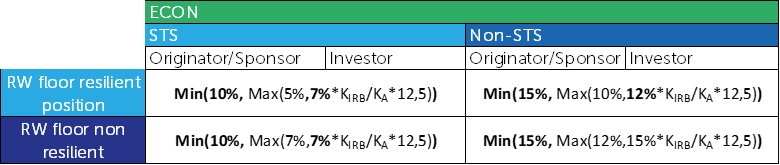
Parliament also follows the EC proposal of risk-sensitive risk weight floors with a more aggressive reduction of the factors and minimum levels. Parliament also introduces caps of 10% for STS and 15% to the risk weight floors for non-STS in SEC-SA in order not to reach floors higher than under the current framework.
The proposed changes go well beyond the quantitative changes described so far. The changes include principle-based requirements adjusted by tranche seniority, exemptions for EU-supervised originators, lighter checks for multilateral development bank (MDB)-guaranteed positions, and waivers for first-loss tranches of at least 15% backed by public entities (e.g., governments, central banks, MDBs).
The proposal introduces greater flexibility in risk retention rules: the standard 5% minimum requirement can be waived entirely if the securitization includes a first-loss tranche of at least 15% of the nominal value of the securitized exposures that is guaranteed or held by specified public entities (such as governments, central banks, multilateral development banks, or promotional institutions).
For the Simple, Transparent and Standardized (STS) framework, the rules are eased for securitizations backed by SME loans: the homogeneity requirement is relaxed, so a pool is deemed compliant if at least 70% (instead of the current 100%) of the underlying exposures consist of SME loans. The Council tightens somewhat those rules and adds additional safeguards although overall supporting the changes proposed by the EC while the Parliament proposed a more radical simplification of the homogeneity requirement.
Additionally, eligibility for unfunded credit protection as credit enhancement is expanded to include qualifying (re-)insurance undertakings under Solvency II. Despite the concerns of ECB, Council and Parliament are supportive of this change, only adding additional requirements based on credit rating.
To improve supervisory consistency, the proposal establishes a new sub-committee on Securitization reporting to the Joint Committee of the European Supervisory Authorities (ESAs). This committee will promote harmonized supervisory practices across the EU and enable the designation of lead supervisors for cross-border securitizations.
On the prudential side, CRR changes shift Significant Risk Transfer (SRT) to a more principle-based approach. The junior tranches must absorb lifetime EL, with at least 50% of unexpected losses transferred to third parties. Originators can self-assess and submit to national authorities. The new category of resilient securitization positions qualifies for preferential treatment.
During the remainder of 2026, the proposals will be subject to Trilogue negotiation between the European Commission, the European Parliament and the Council with the formal adoption expected in late 2026 or early 2027. Some uncertainties hope to be resolved by end of 2026 when the final agreement is reached by the end of the Irish presidency.
The overall view of the ECB is more conservative than the proposal of the EC. It is the view of the ECB that a move away from significant-risk-transfers (SRT’s) to wards true-sale securitization (traditional securitizations) would best accomplish the goals of the European commission. While both true-sale and synthetic securitization move the credit risk away from the loan originator, the synthetic securitizations lack the funding component and therefore contribute significantly less to the new lending. The ECB is overall slightly skeptical about the amount of securitization that will be created just by regulatory changes, and points out that Government Sponsored Enterprises in the US, rather than a different regulatory climate, are responsible for the sizeable US securitization market.
Overall, the package promises meaningful relief: lower costs, clearer rules, better capital efficiency, and alignment with market requests. Were the amendments implemented, it could boost issuance and support economic growth via improved funding channels, without undermining safeguards. The ECB’s opinion of the proposal is more conservative, erring on the side of resilience rather than risk sensitivity. Whether the new CRR and SECR will look more like the ambitious reforms the EC proposes, or look like the more measured stance by the ECB one thing is certain: securitizations will increasingly play an important role for European banks.
Do you want to know how securitization can help free up capital at your bank? How to structure deals today to profit from additional capital relief in the future? At Finalyse, we have engaged with bulge-bracket banks in Europe to support their securitization journey with our proprietary solutions.
Our consultants bring hands-on experience across regulatory, risk, and operational dimensions of capital optimization and securitization projects, enabling institutions to move from concept to execution with confidence.
The European Commission published its proposals to amend the Securitisation Regulation (SECR) and the Capital Requirements Regulation (CRR) in June 2025. The ECB gave its opinion on 11 November 2025, and a month later ECON published its draft report and the Council adopted its position. The European Parliament adopted the ECON report on 5 May 2026 after amendments from MEPs. Trilogue negotiations between the Commission, Council and Parliament start in the second half of 2026, with a final agreement targeted by the end of the Irish presidency. Formal adoption is expected in late 2026 or early 2027.
Resilient securitisation positions are a new category of senior positions proposed in CRR Article 243. They qualify for lower capital requirements because they carry low agency and model risk and have enough loss-absorbing capacity. For STS positions, the only additional requirement is a minimum level of credit enhancement: the attachment point must be at least 1.5 times K_A under SEC-SA and SEC-ERBA, or 1.1 times (EL × WAL + UL) under SEC-IRBA. Under the Commission proposal, the minimum risk weight floor for senior STS positions would be 5% if they are resilient, compared with 7% if they are not. The ECB estimates that around 60% of STS positions already meet the criteria. The Council keeps the Commission’s approach, including non-STS resilient positions, while Parliament would treat all senior STS tranches of traditional securitisations as resilient.
The Commission proposes replacing today’s flat floors of 10% for STS and 15% for non-STS positions with risk-sensitive floors. These would be based on the riskiness of the underlying pool (K_IRB or K_A), with minimum levels depending on whether a position is STS and resilient. The ECB considers this too risk-sensitive and prefers flat floors, lowered only for originators of resilient positions. The Council and Parliament both support the risk-sensitive approach. The Council adjusts the factors and minimum levels in favour of low-risk securitisations, while Parliament proposes more aggressive reductions. Parliament also caps the floors under SEC-SA at 10% for STS and 15% for non-STS, so they can never be higher than under the current framework.
Finalyse InsuranceFinalyse offers specialized consulting for insurance and pension sectors, focusing on risk management, actuarial modeling, and regulatory compliance. Their services include Solvency II support, IFRS 17 implementation, and climate risk assessments, ensuring robust frameworks and regulatory alignment for institutions. |

Check out Finalyse Insurance services list that could help your business.
Get to know the people behind our services, feel free to ask them any questions.
Read Finalyse client cases regarding our insurance service offer.
Read Finalyse blog articles regarding our insurance service offer.
Designed to meet regulatory and strategic requirements of the Actuarial and Risk department
Designed to meet regulatory and strategic requirements of the Actuarial and Risk department.
Designed to provide cost-efficient and independent assurance to insurance and reinsurance undertakings
Finalyse BankingFinalyse leverages 35+ years of banking expertise to guide you through regulatory challenges with tailored risk solutions. |

Designed to help your Risk Management (Validation/AI Team) department in complying with EU AI Act regulatory requirements
A tool for banks to validate the implementation of RWA calculations and be better prepared for CRR3 in 2025
In 2027, FRTB will become the European norm for Pillar I market risk. Enhanced reporting requirements will also kick in at the start of the year. Are you on track?
Finalyse ValuationValuing complex products is both costly and demanding, requiring quality data, advanced models, and expert support. Finalyse Valuation Services are tailored to client needs, ensuring transparency and ongoing collaboration. Our experts analyse and reconcile counterparty prices to explain and document any differences. |

Helping clients to reconcile price disputes
Save time reviewing the reports instead of producing them yourself
Helping institutions to cope with reporting-related requirements
Be confident about your derivative values with holistic market data at hand
Finalyse PublicationsDiscover Finalyse writings, written for you by our experienced consultants, read whitepapers, our RegBrief and blog articles to stay ahead of the trends in the Banking, Insurance and Managed Services world |

Finalyse’s take on risk-mitigation techniques and the regulatory requirements that they address
A regularly updated catalogue of key financial policy changes, focusing on risk management, reporting, governance, accounting, and trading
Read Finalyse whitepapers and research materials on trending subjects
About FinalyseOur aim is to support our clients incorporating changes and innovations in valuation, risk and compliance. We share the ambition to contribute to a sustainable and resilient financial system. Facing these extraordinary challenges is what drives us every day. |

Finalyse CareersUnlock your potential with Finalyse: as risk management pioneers with over 35 years of experience, we provide advisory services and empower clients in making informed decisions. Our mission is to support them in adapting to changes and innovations, contributing to a sustainable and resilient financial system. |