


Designed to incorporate climate-related and environmental risk considerations into your risk management, governance, ICAAP and disclosures
Designed to meet ECB requirements asking banks to perform comprehensive, sound, and forward-looking physical risk assessments.
NAVIGATE ESG DATA MANAGEMENT AND REPORTING SEAMLESSLY WITH OUR EXPERT GUIDANCE.

Lorenzo Rizzo is a finance professional with nearly 9 years of experience in multiple areas of credit risk, especially in model development and validation. His expertise spans PD, LGD and EAD models under both the IRB and IFRS 9 frameworks for corporate and retail portfolios, including independent validation, back testing and regulatory compliance assessments. He also has experience in climate risk, such as ESG data integration and climate stress testing on key risk parameters.
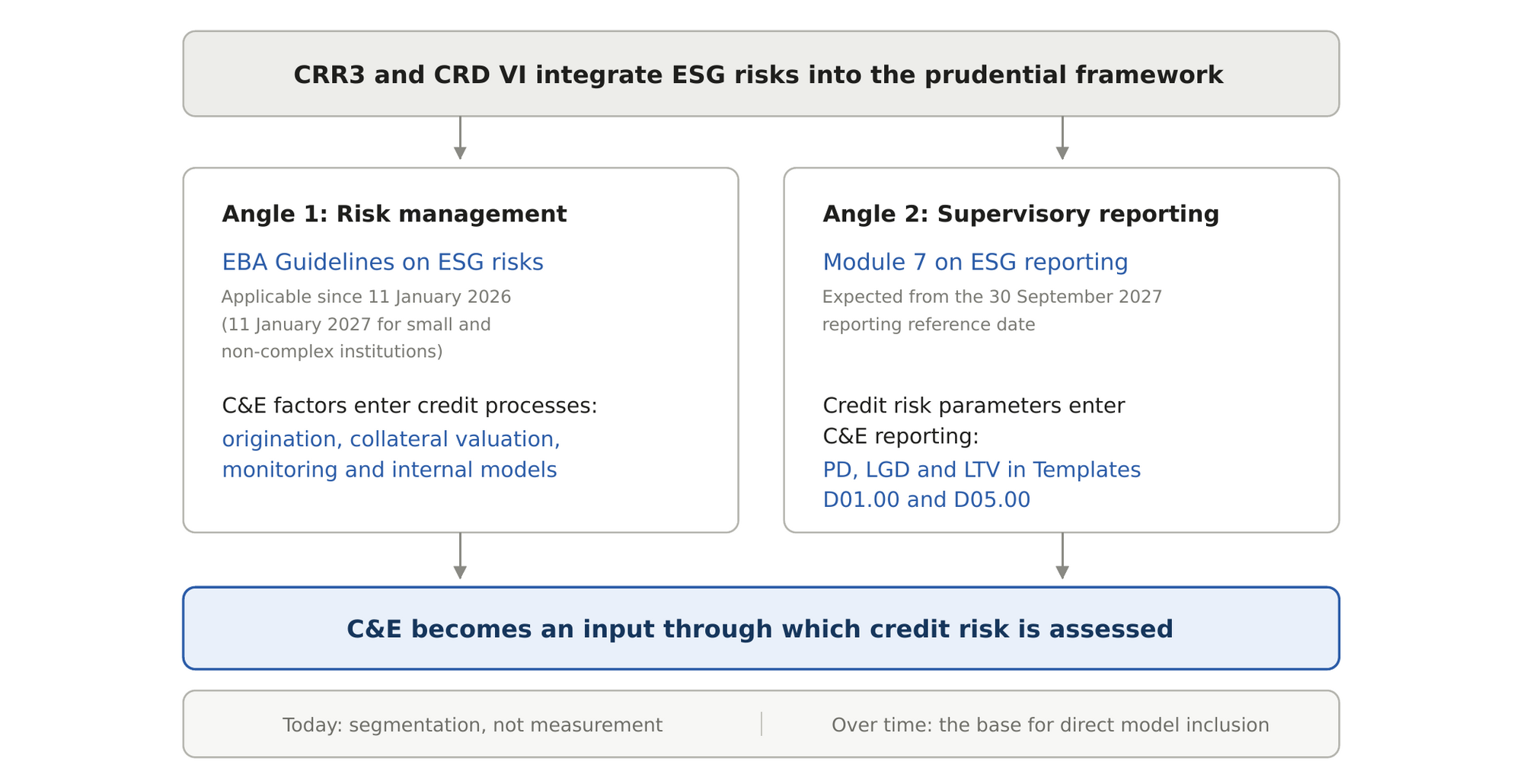
The integration of ESG risks into the prudential framework through CRR3 and CRD VI has produced two distinct sets of obligations for institutions. On the one hand, ESG risk management has become part of the regulatory framework applicable to institutions, with supervisory expectations on how C&E (Climate & Environmental) factors should be reflected in credit processes, internal models and collateral valuation. On the other hand, the EBA has been mandated to develop ITS on supervisory reporting of ESG risks, to allow competent authorities to monitor and assess institutions’ compliance consistently across Member States.
Both components of the framework are usually discussed separately. The first belongs to risk management and is associated with the EBA Guidelines on the management of ESG risks, applicable since 11 January 2026, and from 11 January 2027 at the latest for small and non-complex institutions. The second belongs to supervisory reporting and has taken shape through the proposed Module 7 on ESG reporting: published for consultation in April 2026 and expected to apply from the 30 September 2027 reporting reference date.
Considered together, they describe a single regulatory objective observed from two distinct angles. C&E information is being introduced into credit risk processes, while credit risk parameters are being introduced into C&E reporting templates. The supervisor is therefore advancing on both risk measurement and disclosures, asking institutions to recognise C&E drivers within their assessment of borrower risk and, at the same time, asking them to report conventional risk parameters along C&E dimensions.
This article examines both components of the framework and the conditions under which C&E factors can currently be integrated into credit risk parameters.
The premise of the supervisory approach is that C&E factors should be considered as part of traditional risk categories, rather than as a separate risk type. For credit risk, the transmission channels are reasonably well identified.
Physical risk affects LGD most directly, through lower collateral valuations for portfolios such as real estate that are exposed to natural hazards. Yet, it can also lead to PD impacts, in the event of operational interruptions and other impacts on the borrower's activity. Transition risk affects primarily PD, since energy efficiency standards can generate substantial adjustment costs and reduce corporate profitability, though it may also affect LGD through the devaluation of assets (machinery, equipment) that are carbon intensive. In both instances, the effect reaches institutions through channels they already measure with traditional prudential indicators.
Institutions are expected to consider C&E risks across all relevant stages of the credit granting process, tracking how they affect a borrower's probability of default and identifying the factors that are material. Where properties are taken as security, their physical location and energy efficiency should be known and used in valuation processes. The requirement therefore operates at exposure level and at the time of origination, not only as a portfolio overlay.
The expectation extends beyond the individual lending decision. Sectoral credit policies reflecting C&E risks should be cascaded into clear origination criteria and made available to business staff and credit decision makers. C&E risks should also be incorporated into the credit risk monitoring framework rather than being considered exclusively at origination. Based on their own materiality assessment and risk appetite indicators, institutions are expected to set quantitative credit risk metrics covering the most significant client segments, collateral types and risk mitigation instruments.
The most demanding requirement relates to internal models. C&E factors must be adequately reflected in internal risk classification procedures and considered in the overall assessment of a borrower's default risk. Moreover, material C&E factors are expected to be incorporated into risk indicators, credit scoring or internal rating models. The materiality condition is not incidental. It is the mechanism through which the framework distinguishes between a C&E factor that genuinely affects credit quality and one that does not.
Supervisory expectations also point to C&E data collection, since the next generation of models will need to account for these factors throughout the modelling process. In the meantime, institutions are expected to refine override frameworks to incorporate C&E risk, since including these drivers directly in models is often not yet feasible and credit officers responsible for rating assignment and loan approval require clear guidance.
Reporting credit risk along C&E dimensions is a recent component of the framework. In April 2026 the EBA launched a public consultation on a major revision of its Implementing Technical Standards (ITS), as part of its effort to create a supervisory reporting simplification package. A key element of the proposal is the introduction of Module 7, which establishes a dedicated supervisory reporting framework for ESG risks. The consultation closed in July 2026, and assuming a go-ahead, the new requirements are expected to be applied from the 30 September 2027 reporting reference date onwards.
Unlike existing ESG disclosures, which mainly focus on market transparency, Module 7 introduces ESG reporting into the prudential supervisory framework through a dedicated data collection process.
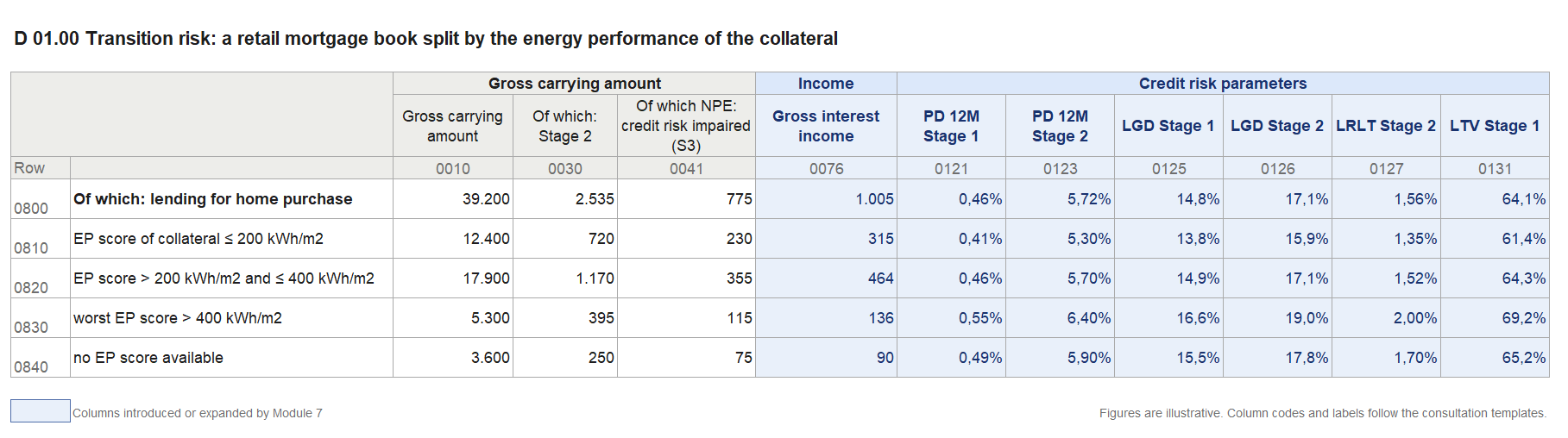
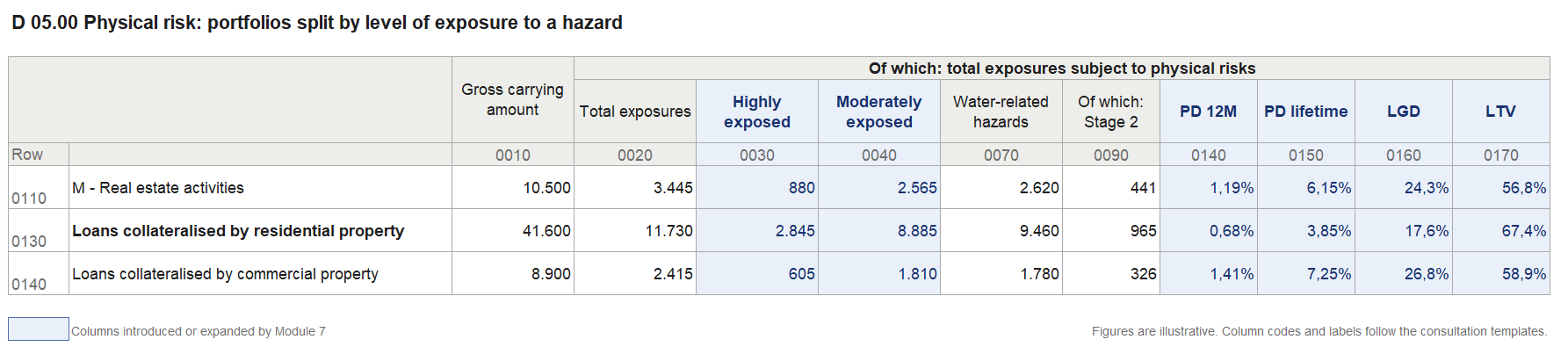
The most significant aspect in the proposal is that the existing transition risk and physical risk templates have been expanded, instead of being replaced by a separate C&E reporting framework. Template D01.00 for transition risk and Template D05.00 for physical risk now include credit risk metrics, additional financial information and more granular C&E classifications. As a result, ESG reporting no longer focuses exclusively on C&E exposures but, instead, combines C&E and credit risk information within the same supervisory framework.
Under the previous framework, institutions primarily reported exposures most exposed to C&E risks, classified by sector, geography and other characteristics (hazard, emissions intensity, etc.). Module 7 retains these dimensions but complements them with credit risk indicators such as PD (both on a twelve month and on a lifetime basis), LGD and LTV.
The EBA proposes that template D 01.00 applies only to large institutions with total assets of at least EUR 30 billion, while template D 05.00 applies to all large institutions.
For transition risk, Template D01.00 extends the analysis beyond credit quality by introducing:
gross interest income;
gross fee and commission income;
the Transition Rate (TR): that is, the probability of an exposure moving between stages during the year;
the Lifetime Loss Rate (LRLT): the lifetime loss rate applied to stage 2 exposures.
These additional details allow supervisors to assess not only the potential risk associated with transition sensitive portfolios, but also their economic relevance and their expected evolution over time.
For physical risk, the most significant enhancement is the increased granularity of exposure classification. Instead of distinguishing only between exposed and non-exposed assets, institutions must now differentiate between highly and moderately exposed assets. Combined with the new credit risk metrics, this provides a clearer picture of portfolio vulnerability. Supervisors can identify not only whether a property is in an area exposed to a physical hazard, but also whether the same exposure is associated with a high PD, an elevated LTV or other signs of weaker credit quality.
The added value of the revised framework therefore comes from combining C&E information with prudential metrics within the same reporting templates. This allows supervisors to identify areas of concentration, where C&E-related vulnerabilities coincide with weaker credit quality. This approach provides a richer understanding of portfolio risk compared to when both dimensions (C&E and credit risk) were assessed individually.
In practice institutions face three main operational hurdles in producing this information:
many required C&E data points are not yet systematically available across portfolios;
C&E data, financial reporting and prudential risk parameters are traditionally managed through separate legacy systems, each with its own methodology and validation rules;
unlike financial reporting, which is largely derived from established accounting systems, C&E data requires separate mapping and sourcing. Hence, reconciling these distinct data flows at exposure level becomes one of the main implementation challenges.
As C&E information becomes directly linked to prudential indicators, the quality of physical risk models, hazard maps and exposure classifications becomes increasingly relevant to supervisory reporting. Weak data or simplified modelling assumptions no longer affect only disclosures but also influence the overall risk profile presented to supervisors.
Supervisory reporting therefore becomes an indirect indicator of the robustness of an institution's C&E risk modelling framework. Weaknesses in hazard mapping, exposure classification or data quality are more likely to translate into visible concentrations within reported portfolios.
The consequence is that C&E data is no longer used solely for compliance purposes. It becomes part of prudential risk analysis, encouraging institutions to progressively embed C&E considerations into existing credit risk processes rather than treating them as a standalone ESG reporting exercise.
C&E information, however, is used to segment exposures, not to measure the prudential parameters themselves. Module 7 does not require parameters recalibrated on C&E drivers. It requires conventional parameters, produced by existing models, grouped along C&E dimensions.
Indeed, as previously mentioned, a direct integration of C&E factors within credit risk modelling remains complex. Two conditions would have to be met to achieve robust modelling practices, and neither is generally met today. The first is historical depth: model performance is assessed against observed past defaults, which makes it difficult to validate factors that have not yet materialised or been measured. The second concerns information content: where a C&E factor has already affected a counterparty, its impact is typically visible in financial statements and collateral values before default, so a C&E variable tends to be correlated with drivers already in the model. Direct inclusion is justified where the factor captures a genuine residual relationship, not already explained by existing drivers.
Hence, upcoming reporting standard will apply C&E factors as a means of segmentation rather than measurement. The expectation is that, over successive reference dates, segmented reporting will build the observational base that is currently lacking for direct inclusion in prudential risk model estimation.
C&E factors are entering credit risk from two angles:
Supervisory expectations require them to be reflected in the assessment of borrower risk, in collateral valuation and, when material, in internal models.
Module 7 requires conventional credit risk parameters to be presented along C&E dimensions.
Risk management expectations are already applicable, while the reporting framework is expected to apply from the second half of 2027. This means that reporting requirements can be implemented while institutions continue to integrate C&E factors into their credit risk management practices, with the more comprehensive supervisory dataset still under construction.
Open challenges remain, notably how C&E factors can be introduced into PD and LGD estimation, and how forward-looking instruments such as scenario analysis and stress testing can capture risks that historical data cannot.
What changes in the meantime is the status of C&E information itself, which ceases to be only a reporting obligation and becomes an input through which credit risk is assessed.
The two angles described in this article call for two kinds of work, and Finalyse supports banks on both.
On the risk management side, the starting point is understanding which C&E factors genuinely matter. We help institutions assess the materiality of physical and transition risk and translate it into credit policies, origination criteria and monitoring metrics (Sections 2.1 and 2.2). Where those factors belong in internal models, our credit risk modelers and validators help reflect them, and design the override frameworks that guide credit officers until direct inclusion becomes feasible (Section 2.3).
On the reporting side, Module 7 is as much a data challenge as a regulatory one. We support banks in assessing their gaps against Templates D01.00 and D05.00 and in implementing them consistently with IFRS 9 metrics (Sections 3.1 to 3.4). Behind the templates, we help source and reconcile C&E, financial and prudential data at exposure level, the hurdle most institutions will face first (Section 3.5). Done well, this segmentation also builds the observational base that future model recalibration will need (Section 3.6).
Finally, the questions this article leaves open, from C&E factors in PD and LGD estimation to forward-looking risks that history cannot capture, are where our climate stress testing and scenario analysis work begins.
To discuss how these requirements apply to your institution, contact our banking team at banking@finalyse.com.
The guidelines require banks to consider material climate and environmental risks in credit origination, borrower assessments, collateral valuation, ongoing monitoring and internal risk classification.
Module 7 is a proposed ESG supervisory reporting framework that integrates credit risk indicators, including PD, LGD and LTV, into climate-related reporting templates. It is expected to apply from the September 2027 reporting reference date.
Physical climate risks can reduce collateral values and increase LGD, while transition risks can affect borrower profitability and increase PD. However, directly incorporating climate factors into credit risk models remains challenging due to limited historical data.
Finalyse InsuranceFinalyse offers specialized consulting for insurance and pension sectors, focusing on risk management, actuarial modeling, and regulatory compliance. Their services include Solvency II support, IFRS 17 implementation, and climate risk assessments, ensuring robust frameworks and regulatory alignment for institutions. |

Check out Finalyse Insurance services list that could help your business.
Get to know the people behind our services, feel free to ask them any questions.
Read Finalyse client cases regarding our insurance service offer.
Read Finalyse blog articles regarding our insurance service offer.
Designed to meet regulatory and strategic requirements of the Actuarial and Risk department
Designed to meet regulatory and strategic requirements of the Actuarial and Risk department.
Designed to provide cost-efficient and independent assurance to insurance and reinsurance undertakings
Finalyse BankingFinalyse leverages 35+ years of banking expertise to guide you through regulatory challenges with tailored risk solutions. |

Designed to help your Risk Management (Validation/AI Team) department in complying with EU AI Act regulatory requirements
A tool for banks to validate the implementation of RWA calculations and be better prepared for CRR3 in 2025
In 2027, FRTB will become the European norm for Pillar I market risk. Enhanced reporting requirements will also kick in at the start of the year. Are you on track?
Finalyse ValuationValuing complex products is both costly and demanding, requiring quality data, advanced models, and expert support. Finalyse Valuation Services are tailored to client needs, ensuring transparency and ongoing collaboration. Our experts analyse and reconcile counterparty prices to explain and document any differences. |

Helping clients to reconcile price disputes
Save time reviewing the reports instead of producing them yourself
Helping institutions to cope with reporting-related requirements
Be confident about your derivative values with holistic market data at hand
Finalyse PublicationsDiscover Finalyse writings, written for you by our experienced consultants, read whitepapers, our RegBrief and blog articles to stay ahead of the trends in the Banking, Insurance and Managed Services world |

Finalyse’s take on risk-mitigation techniques and the regulatory requirements that they address
A regularly updated catalogue of key financial policy changes, focusing on risk management, reporting, governance, accounting, and trading
Read Finalyse whitepapers and research materials on trending subjects
About FinalyseOur aim is to support our clients incorporating changes and innovations in valuation, risk and compliance. We share the ambition to contribute to a sustainable and resilient financial system. Facing these extraordinary challenges is what drives us every day. |

Finalyse CareersUnlock your potential with Finalyse: as risk management pioneers with over 35 years of experience, we provide advisory services and empower clients in making informed decisions. Our mission is to support them in adapting to changes and innovations, contributing to a sustainable and resilient financial system. |