



Divyank Garg is a Fellow of the Institute and Faculty of Actuaries (FIA) with more than ten years of experience in the life insurance and reinsurance industry, across consulting and in-house roles. A subject matter expert in Solvency II, BMA EBS, IFRS 17 and statutory valuation, he has advised insurers and reinsurers across Europe, Asia, North America and Bermuda on regulatory reporting, management reporting, and capital and risk management. Divyank has led and delivered major actuarial and regulatory transformation programmes, and has built and managed teams supporting financial reporting, actuarial modelling and model governance.
For a decade, the volatility adjustment (VA) has been a figure published monthly by EIOPA and applied uniformly by every undertaking with obligations in the same currency. From 30 January 2027, EIOPA will publish the Risk-Corrected Spread (RCS). The VA itself becomes something each undertaking calculates for itself.
The consequence: two undertakings with identical liabilities, reporting on the same date in the same currency, may legitimately apply different VAs. The measure moves from being an input drawn from the market to an output of the balance sheet.
This article sets out what the new formula for the VA contains, what determines its size, and four consequences that follow for asset-liability management.
The currency VA becomes:
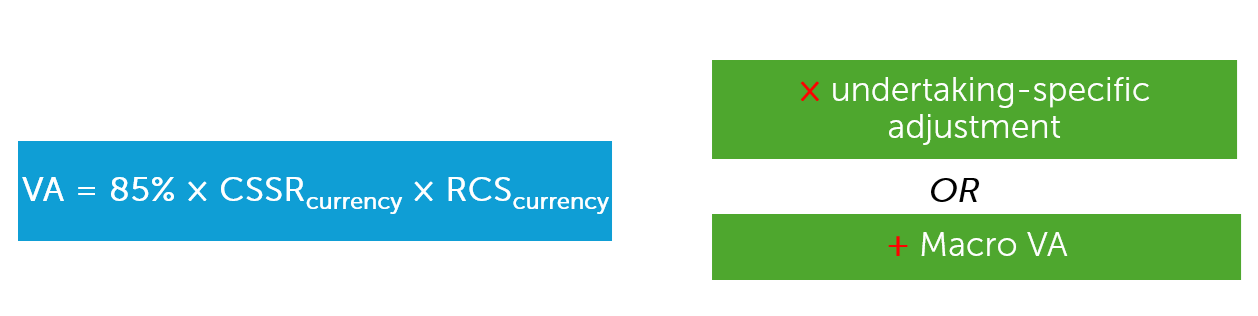
Where:
Macro VA: GAR85% × CSSREuro × max (RCScountry – 1.3 × RCSEuro ; 0) × ωcountry
Three changes sit inside that expression.
The general application ratio rises from 65% to 85%. The RCS is published by EIOPA and may be adjusted by an undertaking-specific adjustment (USA). And a new undertaking-specific factor, the credit spread sensitivity ratio (CSSR), is applied.
For undertakings with euro-denominated obligations there is a further component. Those that do not apply a USA must instead apply a macroeconomic VA, calculated by reference to the country reference portfolio and scaled by a country adjustment factor. The two are mutually exclusive, and the technical documentation (RFR Technical Documentation, Risk and Financial Stability Department, EIOPA, May 2026) is explicit that where the USA is not used, the macroeconomic component is not optional.
The USA is worth noting for its asymmetry. It is the lower of 105% and the ratio of the RCS of the undertaking's own bond portfolio to the published figure. Capped above, it has no floor. An undertaking holding a portfolio of higher credit quality and lower spread than the reference portfolio could find the adjustment materially below 100%, reducing its VA accordingly.
The CSSR compares the spread sensitivity of an undertaking's fixed-income (FI) assets with the interest-rate sensitivity of its best estimate liabilities (BEL):
CSSR = max[ min( ΔFI / ΔBEL ; 1 ) ; 0 ]
ΔFI : the notional VA value of fixed income (FI) assets minus their market value
ΔBEL : the notional VA value of BEL minus its market value
Both terms are calculated by full revaluation. The undertakings are expected to construct a notional VA curve, the CSSR-curve, by adding a notional VA of 85% of the RCScurrency to the continuously compounded risk-free forward rates provided by EIOPA. FI assets and the BEL are then revalued on this curve, and the two changes are compared.
The notional VA applies to the forward rates up to the first smoothing point (FSP), but the last liquid forward rate used for extrapolation is itself adjusted, so the effect carries beyond the FSP rather than stopping there. In an illustrative euro construction of risk-free curve with and without notional VA at June-end 2026, the spot-rate difference runs at roughly 32 basis points (bps) to twenty years, 26 bps at thirty years and 16 bps at fifty years. Liability cash flows well beyond the FSP therefore influence the denominator in the CSSR calculation.
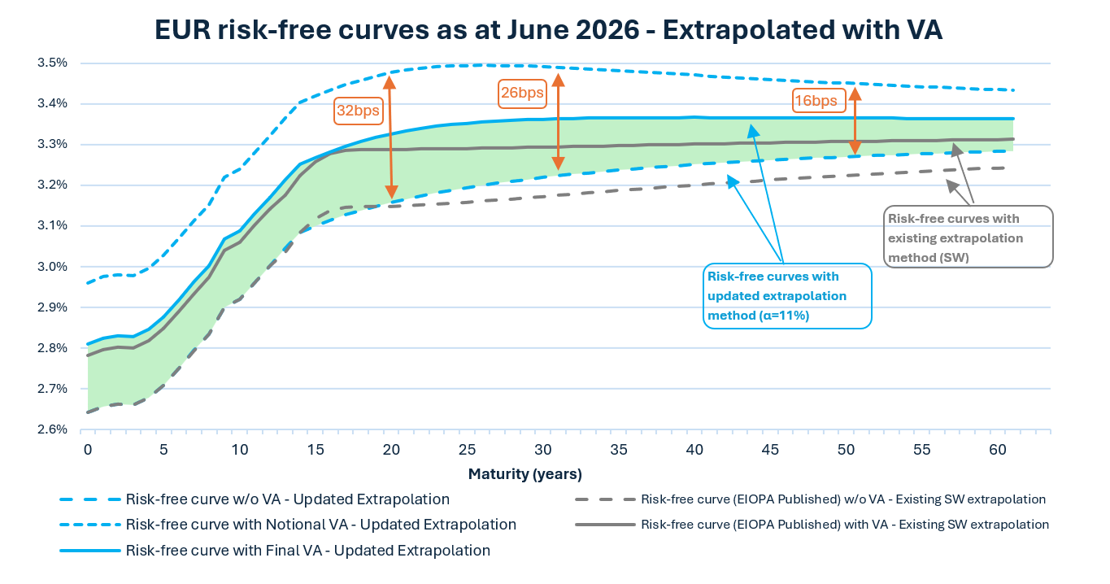
The asset and liability legs are not treated symmetrically. The change in FI value is measured against its market value, so each holding's own credit spread appears in both the base and shocked valuations. The BEL carries no spread risk. Its market value is its value on the basic risk-free curve.
To illustrate the scale, an internally constructed model of a mid-sized life undertaking with a bond portfolio spanning government, corporate, covered, structured and mortgage exposures, and a liability profile combining annuities in payment, deferred annuities, endowment and term business, produces a CSSR of approximately 51.8%. Against an RCS of 36.3 bps, that translates to a VA of roughly 15.99 bps, compared with 30.9 bps had the CSSR ratio been unity. The difference of around 15 bps is the cost of spread-sensitivity mismatch. These figures are illustrative, depend on assumptions set out further in this article, and should not be read as representative of any undertaking.
Because the numerator in the CSSR measures how asset values respond to a shift in the discount curve, an asset's marginal contribution depends principally on its spread duration rather than its spread level. In the illustrative portfolio, holdings rank by marginal contribution almost exactly in order of duration:
| Illustrative holding | Duration (yrs) | Marginal VA per €10m invested |
| Long-dated government bonds | 12.3 | 0.80 bps |
| Medium-dated government bonds | 10.2 | 0.66 bps |
| Covered bonds | 7.2 | 0.47 bps |
| Residential mortgage portfolio | 4.3 | 0.28 bps |
| Money-market instruments | 1.0 | 0.07 bps |
A holding of twelve years' duration contributes roughly three times as much per euro invested as one of four years, regardless of the spread either carries. Amortising exposures such as mortgages have materially shorter durations than their term suggests and contribute accordingly.
Investment decisions oriented towards return maximisation will not necessarily result in a materially higher VA and may in fact forgo some VA where the incremental spread is generated through credit selection at the shorter end of the curve, rather than through duration extension. Return and the VA were never previously in tension, because the VA did not depend on portfolio composition at all.
Derivatives do not appear in either leg of the reference portfolio classification set out in the technical documentation and are therefore excluded from the fixed-income term. The denominator, meanwhile, is the BEL, which is unhedged by construction. An interest-rate swap programme consequently contributes nothing to either side of the ratio.
Swaps do not, of themselves, reduce the CSSR. Adding a swap programme to a bond portfolio leaves both terms of the ratio, and the VA, unaffected.
The choice of instrument used to close a duration gap now has a consequence it did not previously have. Consider two allocations of an identical bond portfolio, constructed so that total duration exposure, including swaps, is the same:
| Long-bond allocation | Swap & short-bond allocation | Difference | |
| Long-dated bonds | Difference | €209m | -€91m |
| Short-dated bonds | €94m | €185m | €91m |
| Swap notional | Nil | €75m* | €75m |
| Duration of bond holdings | 11.4 yrs | 8.5 yrs | -2.9 yrs |
| Duration of the portfolio | 11.4 yrs | 11.4 yrs | - |
| CSSR | 91% | 68% | -23 pp |
| Volatility adjustment | 28.05 bps | 21.03 bps | -7.02 bps |
*The long-bond holding in the second allocation is solved so that total duration exposure, including the swap, equals that of the first. The swap supplies the 2.9 years of duration removed from the bond portfolio.
The effect on own funds and the solvency ratio depends on liability duration and the undertaking's own capital position, but the direction is unambiguous. The allocation holding more of its duration in bonds attracts the higher adjustment.
The long-dated bonds allocation earns the higher adjustment but it also ties up more spread risk capital. The swap allocation avoids that charge, at the cost of collateral calls and counterparty exposure. Both allocations involve a trade-off. What has changed is that the VA now falls on one side of it rather than neither.
A further consideration arises for undertakings with euro-denominated obligations. It is a supervisory question rather than a technical one.
Mortgages and loans fall within the corporate leg of the reference portfolio classification. Calculating a risk correction for them requires a long-term average spread (LTAS), which Article 51(4) of the Delegated Regulation (EU Delegated Regulation amending Delegated Regulation (EU) 2015/35) requires to be based on thirty years of data, with unavailable data replaced by constructed data on prudent assumptions.
EIOPA publishes LTAS for government exposures by country and for corporate exposures by currency, sector and credit quality step. No series is published for mortgages or loans. It acknowledges the position that no model bonds have been developed for securitisations and loans, including mortgage loans, "due to the lack of data" (G.1.3 - RFR Technical Documentation, Risk and Financial Stability Department, EIOPA, May 2026), with any specific treatment deferred until the relevant information becomes available.
An undertaking holding a material mortgage portfolio must therefore construct or map an LTAS and satisfy its supervisory authority both that the mapping is appropriate and that the underlying data is of sufficient quality. That determination is not within the undertaking's control, and the USA requires separate prior approval in any event.
Three routes therefore lead to the same destination, the first two governing access, the third a matter of attractiveness:
Where a mapping cannot be agreed, the USA is unavailable
Where it can be agreed but the published RCS has not exceeded the undertaking's own in each of the four preceding quarterly reporting periods (likely for portfolios richer in spread than the reference portfolio), the eligibility condition is not met
Where both are satisfied, the adjustment may still reduce the VA below the published RCS, while declining to apply it produces the same outcome as being ineligible
In each case, the macroeconomic component applies. For undertakings in this position, the discount curve becomes partly dependent on sovereign spreads in other member states, an exposure that arises through the valuation framework rather than through any holding, and which cannot readily be hedged.
The illustrative undertaking ends close to where it started: 14 bps VA published today, 15.99 bps under the revised framework, 13.74 bps once the undertaking-specific adjustment applies. On that evidence the transition is not a balance-sheet event.
Each of the preceding sections, however, moved the VA figure. A CSSR of 51.8% forgoes roughly half of the 30.9 bps available at a ratio of one. Holding duration in swaps rather than bonds, at unchanged interest-rate exposure, costs a further 7 bps. The undertaking-specific adjustment, once eligible, removes 2.25 bps more. None of these decisions previously touched the volatility adjustment.
That turns the analysis into three questions an undertaking can already answer from data EIOPA publishes. How far the CSSR sits from unity, since that gap is the adjustment being forgone. How much of the duration position is held in derivatives, and what that costs in adjustment terms. And whether the undertaking's own risk-corrected spread sits above or below the published figure, since that determines whether it faces the undertaking-specific adjustment or the macroeconomic component.
The last has a clock attached. The adjustment is optional, but eligibility is retrospective, requiring the published RCS to have exceeded the undertaking's own in each of the four preceding quarterly reporting periods. An undertaking intending to apply it from January 2027 needs the calculation running during 2026.
The figures in this article derive from an internally constructed illustrative model built on the revised extrapolation method applying from 2027, being the first smoothing point and last liquid forward rate approach, validated against EIOPA's published curves. Corporate spread inputs are inferred rather than observed, and mortgage long-term average spreads are assumed in the absence of a published series.
Several aspects of the framework remain subject to further specification in the Delegated Regulation and technical standards. Nothing here constitutes advice, and undertakings should form their own view on the matters discussed in consultation with their advisers and supervisory authority.
Since the introduction of the standardized risk weight floor, the importance of the (p) factor in SEC-SA is of particular importance. The currently applicable (p) factor is in fact lowered in the transitory arrangement for the output floor (CRR article 465) to 0.25 for STS positions and 0.5 for non-STS positions (from 0.5 and 1.0) respectively.
The European Commission published its proposals to amend the Securitisation Regulation (SECR) and the Capital Requirements Regulation (CRR) in June 2025. The ECB gave its opinion on 11 November 2025, and a month later ECON published its draft report and the Council adopted its position. The European Parliament adopted the ECON report on 5 May 2026 after amendments from MEPs. Trilogue negotiations between the Commission, Council and Parliament start in the second half of 2026, with a final agreement targeted by the end of the Irish presidency. Formal adoption is expected in late 2026 or early 2027.
Resilient securitisation positions are a new category of senior positions proposed in CRR Article 243. They qualify for lower capital requirements because they carry low agency and model risk and have enough loss-absorbing capacity. For STS positions, the only additional requirement is a minimum level of credit enhancement: the attachment point must be at least 1.5 times K_A under SEC-SA and SEC-ERBA, or 1.1 times (EL × WAL + UL) under SEC-IRBA. Under the Commission proposal, the minimum risk weight floor for senior STS positions would be 5% if they are resilient, compared with 7% if they are not. The ECB estimates that around 60% of STS positions already meet the criteria. The Council keeps the Commission’s approach, including non-STS resilient positions, while Parliament would treat all senior STS tranches of traditional securitisations as resilient.
The Commission proposes replacing today’s flat floors of 10% for STS and 15% for non-STS positions with risk-sensitive floors. These would be based on the riskiness of the underlying pool (K_IRB or K_A), with minimum levels depending on whether a position is STS and resilient. The ECB considers this too risk-sensitive and prefers flat floors, lowered only for originators of resilient positions. The Council and Parliament both support the risk-sensitive approach. The Council adjusts the factors and minimum levels in favour of low-risk securitisations, while Parliament proposes more aggressive reductions. Parliament also caps the floors under SEC-SA at 10% for STS and 15% for non-STS, so they can never be higher than under the current framework.
Finalyse InsuranceFinalyse offers specialized consulting for insurance and pension sectors, focusing on risk management, actuarial modeling, and regulatory compliance. Their services include Solvency II support, IFRS 17 implementation, and climate risk assessments, ensuring robust frameworks and regulatory alignment for institutions. |

Check out Finalyse Insurance services list that could help your business.
Get to know the people behind our services, feel free to ask them any questions.
Read Finalyse client cases regarding our insurance service offer.
Read Finalyse blog articles regarding our insurance service offer.
Designed to meet regulatory and strategic requirements of the Actuarial and Risk department
Designed to meet regulatory and strategic requirements of the Actuarial and Risk department.
Designed to provide cost-efficient and independent assurance to insurance and reinsurance undertakings
Finalyse BankingFinalyse leverages 35+ years of banking expertise to guide you through regulatory challenges with tailored risk solutions. |

Designed to help your Risk Management (Validation/AI Team) department in complying with EU AI Act regulatory requirements
A tool for banks to validate the implementation of RWA calculations and be better prepared for CRR3 in 2025
In 2027, FRTB will become the European norm for Pillar I market risk. Enhanced reporting requirements will also kick in at the start of the year. Are you on track?
Finalyse ValuationValuing complex products is both costly and demanding, requiring quality data, advanced models, and expert support. Finalyse Valuation Services are tailored to client needs, ensuring transparency and ongoing collaboration. Our experts analyse and reconcile counterparty prices to explain and document any differences. |

Helping clients to reconcile price disputes
Save time reviewing the reports instead of producing them yourself
Helping institutions to cope with reporting-related requirements
Be confident about your derivative values with holistic market data at hand
Finalyse PublicationsDiscover Finalyse writings, written for you by our experienced consultants, read whitepapers, our RegBrief and blog articles to stay ahead of the trends in the Banking, Insurance and Managed Services world |

Finalyse’s take on risk-mitigation techniques and the regulatory requirements that they address
A regularly updated catalogue of key financial policy changes, focusing on risk management, reporting, governance, accounting, and trading
Read Finalyse whitepapers and research materials on trending subjects
About FinalyseOur aim is to support our clients incorporating changes and innovations in valuation, risk and compliance. We share the ambition to contribute to a sustainable and resilient financial system. Facing these extraordinary challenges is what drives us every day. |

Finalyse CareersUnlock your potential with Finalyse: as risk management pioneers with over 35 years of experience, we provide advisory services and empower clients in making informed decisions. Our mission is to support them in adapting to changes and innovations, contributing to a sustainable and resilient financial system. |