

The regulatory landscape for IRRBB is rapidly changing. Are you up to date?

Banking is built around liquidity and maturity transformation. Banks receive funds from customers, often in the form of short-term or on-demand deposits, and transform those funds into longer-term assets such as mortgages, corporate loans, government securities and other balance sheet positions. This process may sound simple, but economically it is complex.
The business model is profitable because, under normal conditions, the yield on assets is higher than the cost of liabilities. This difference is the core of net interest income; the bank’s final profitability then depends on credit, operating, capital, liquidity and hedging costs.
However, transforming short-term funding into long-term assets must be carefully managed. Otherwise, mismatches in liquidity, interest rates and funding structure, as well as other risks, can generate serious economic problems, as shown by the Silicon Valley Bank case in 2023, which is discussed in Finalyse’s article on ALM.
A bank therefore needs a set of mechanisms to manage this transformation effectively. These mechanisms help the bank control its core business: transforming customer funding into productive assets while keeping risks within appetite. In this article, we focus on one of the most important of these mechanisms: Fund Transfer Pricing, or FTP.
This article first explains what FTP is and how a simplified FTP rate is built. It then looks at how deposits, and non-maturity deposits in particular, are valued within the framework, and how Treasury and ALM use FTP to steer business behaviour. Next, we review how several major banks apply FTP in practice, before outlining the features of a sound FTP framework and the challenges institutions face when designing one.
We can define FTP as the internal pricing framework that allows a bank to transfer funds and their associated risks between business units and ALM, translating its balance sheet reality into business decisions. It gives an internal value (an FTP credit) to funds raised by deposit-taking units and an internal cost (an FTP charge) to funds used by lending, investment or other asset-generating units.
FTP emerged as a management tool with two main purposes: measuring the true economic profitability of each activity and transferring interest rate and liquidity risks to where they can be managed. Both purposes start from the same question:
The answer depends on each bank’s specific characteristics. Therefore, FTP is not a universal number: it depends on the institution’s funding structure, deposit base, market access, liquidity position, credit spread, currency, risk appetite and regulatory constraints.
A simplified FTP rate can be built from three main components:
| FTP rate = Base market rate + Bank-specific funding spread + Liquidity cost or premium |
The base market rate reflects the market price of money for the relevant currency and maturity. The bank-specific funding spread reflects the institution’s own cost of raising market funding. It is usually derived from the bank’s marginal wholesale funding, such as senior unsecured debt of the relevant maturity, since this reflects what it would cost to fund a new transaction today. Some institutions instead use a blended spread based on their overall funding mix, while deposits are typically treated separately, as they receive their own FTP credit. The liquidity cost or premium reflects the cost of maintaining funding and liquidity over the life of the asset.
This is where Non-Maturity Deposits (NMD) become highly relevant. A stable and well-modelled NMD base can improve the bank’s understanding of its funding profile and liquidity position. As a result, NMD modelling can influence the FTP framework by affecting the bank-specific funding spread, the liquidity premium and the internal value assigned to stable deposits.
For deposits, the bank needs to understand their economic behaviour. A deposit is not priced only according to the interest paid to the customer. Its value also depends on its stability, expected duration, liquidity value and sensitivity to market rates.
This is especially important for NMDs, such as current accounts and savings accounts. These products are contractually payable on demand, but part of their balances tends to remain with the bank over time. Under the EU IRRBB framework (Commission Delegated Regulation (EU) 2024/857, Articles 1 and 7), NMDs are segmented in two steps. First, the stable part is the portion of balances that is likely to remain undrawn under current interest rates; the remainder is non-stable. Second, within the stable part, the core component is the portion that is unlikely to reprice even under significant changes in interest rates. Everything else, including all non-stable balances, is treated as non-core. In other words, stability is about volume (whether the money stays), while core is about rate insensitivity (whether its price stays unchanged).
For a deeper view on how NMDs can be modelled, see Finalyse’s article on Non-Maturity Deposit Modelling, which explains that NMD treatment sits at the edge between liquidity management and ALM, and that modelling them correctly supports liquidity needs, interest rate sensitivities, transfer pricing, IRRBB and ILAAP.
The quality of the stable and core segmentation is key. As mentioned earlier, a stable deposit base can reduce the bank-specific funding spread and the liquidity cost or premium, lowering the bank’s FTP rates. However, this benefit only holds if deposit behaviour is estimated correctly. If the stable and core components are underestimated, and most balances are treated as overnight (short-duration deposits), the FTP credit will be low and the deposit business may be under-rewarded. If they are overestimated (long-duration deposits), the FTP credit may be too high and the bank may take excessive structural risk, relying on funding that could leave or reprice when rates change. In practice, the stable part mainly drives the liquidity value of deposits, while the core component determines the tenor used to price their interest rate benefit.
For the core component of NMDs, institutions may use a replicating portfolio approach. Under this technique, core balances are represented as if they were invested in a portfolio of market instruments with different maturities, typically rolled over time. The yield of this portfolio provides the basis for the FTP credit assigned to these deposits, while non-core balances are usually priced at short-term rates.
Once deposits and other funding sources are analysed, the bank can assign an internal price through the FTP framework. The objective is to build internal FTP curves that reflect the economic cost and value of funding across maturities, currencies and products.
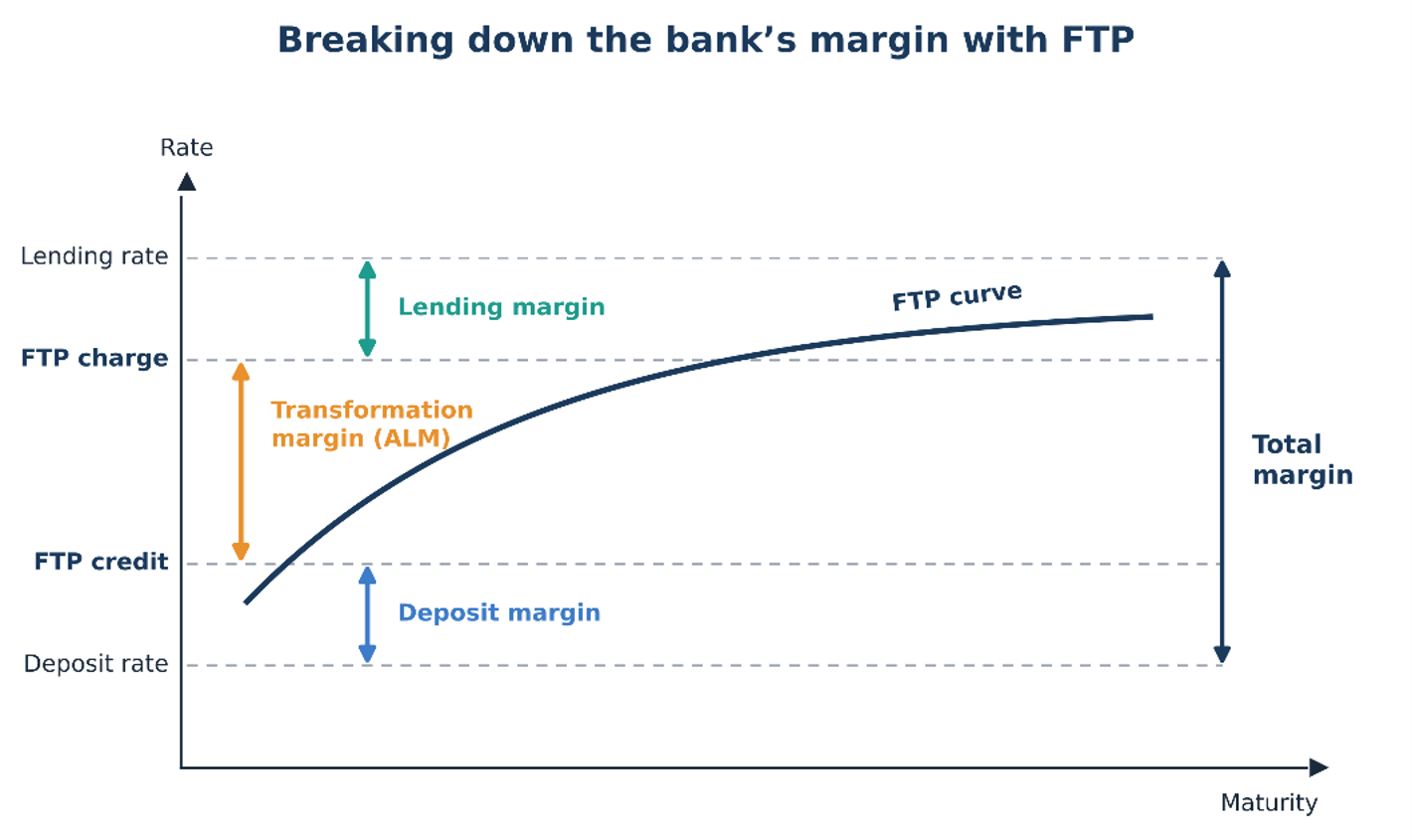
A second element is the governance of the FTP framework. FTP is usually operated by Treasury or ALM and governed by ALCO. Treasury and ALM have several missions: some are related to managing regulatory and supervisory constraints, while others are related to supporting the profitability and sustainability of the banking model through funding, liquidity and interest rate risk management.
Matched-maturity FTP shows how this works in practice. The FTP rate is set from the current market curve when a transaction is originated, reflecting what it would cost to fund it today rather than the bank’s average historical cost of funds, and remains fixed for its whole life, so the business unit’s margin is locked in. If market rates change afterwards, the impact falls on ALM, which manages this risk centrally, not on the business units.
A third element is how FTP helps to steer the balance sheet dynamically. By changing the FTP charge for a specific tenor, currency or product, Treasury and ALM can encourage or discourage certain business activities and help mitigate the liquidity and interest rate risks associated with them. They can also encourage the origination of specific types of deposits by assigning them a more attractive FTP credit. A price-based system is effective because it changes the economic incentives faced by business units.
FTP adjustments are usually supported by internal ALM metrics such as EVE sensitivity, NII sensitivity, duration gaps, repricing gaps and funding needs. These metrics give Treasury and ALM a diagnosis of the current state of the balance sheet, which can be compared with the risk limits set by management. For example, if the bank has excessive exposure to long-term fixed-rate mortgages, this may increase duration risk and make the institution more sensitive to interest rate movements. In that case, Treasury and ALM may increase the FTP charge for the relevant long-term fixed-rate tenors. This compresses the margin of the mortgage business and reduces the incentive to originate those assets. For a better understanding of IRRBB metrics, see Finalyse’s article on managing IRRBB metrics.
On the other hand, if the diagnosis shows that the bank needs more stable funding, the FTP credit assigned to deposits with longer behavioural maturity may be increased. This improves the profitability of the deposit business and gives it an incentive to raise more stable liabilities.
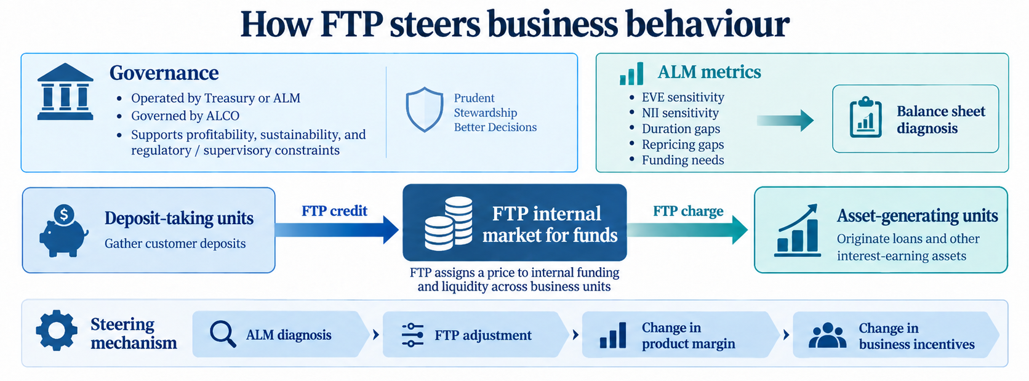
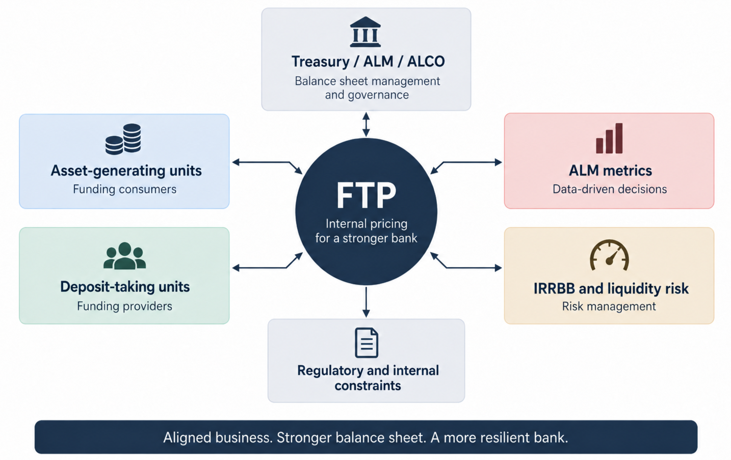
FTP connects Treasury and ALM’s aggregate view of the bank with the allocation and use of resources across business units. Supported by internal metrics, it helps monitor the state of the balance sheet and steer business activity accordingly. This is why a well-developed FTP framework is essential.
While all institutions share the same concept, each adapts FTP to its business model, geographic footprint and balance sheet structure.
JPMorgan Chase. In 4Q 2024, JPMorgan raised the FTP credit on consumer deposits for its retail division (CCB), fully offset in Corporate, where its central treasury (Treasury and CIO) sits. Firm-wide net interest income was unaffected; margin was only reallocated between segments, likely to reward stable deposit funding. (JPMorgan Chase & Co., Form 10-K 2025 — Business Segment & Corporate Results)
BBVA. Applies group-wide principles adapted by geography: internal rates combine a market reference rate by tenor plus a liquidity premium reflecting each area’s market conditions, a premium BBVA raised in 2011 as funding costs increased. (BBVA, Annual Reports and Form 20-F, 2011–2015 — Liquidity and structural interest rate risk.)
Bank of America. Uses matched maturity: each asset and liability receives a rate based on its tenor and interest rate sensitivity. Unlike banks where the central treasury retains the results of balance sheet management, Bank of America allocates most of its ALM results, including deposit pricing and FTP effects, to the business segments, so their reported margins also reflect how the balance sheet is managed. (Bank of America Corp., Form 10-K 2025 — Business Segment Operations, Basis of Presentation.)
Banco Santander. Runs its internal transfer rate (ITR) system, its name for FTP, on two levels: subsidiaries such as Santander México set their own transfer prices for loans and deposits in local and foreign currencies, while Financial Management in the Corporate Centre centralises structural liquidity and interest rate risk. In 2011 it added a duration-based liquidity spread to its base curve.(Banco Santander, Form 20-F 2011 and Form 20-F 2015; Santander México, Form 20-F 2022.)
HSBC. Each entity’s ALCO sets its own transfer curve within a group framework. Unlike banks where FTP transfers all interest rate risk to the central treasury, HSBC transfers only the risk that can be economically hedged to Markets Treasury; any risk that cannot be hedged stays with the global business where it was originated. Its reports also show interest rate and liquidity risk priced separately, the latter linked to internal stress scenarios. (HSBC Holdings plc,Annual Report and Accounts 2015 (Appendix to Risk, p. 207); Form 20-F 2016–2019 — Interest rate risk in the banking book.)
A good FTP framework should provide a consistent and transparent way to price the use and generation of funds inside the bank, so that business decisions reflect the real economics of the balance sheet. In practice, this means capturing the relevant funding and liquidity costs of each product: the base market rate, the institution’s own funding spread, the term liquidity cost and, when relevant, behavioural, optionality, basis or currency adjustments.
Building such a framework is not without challenges. First, FTP results depend heavily on methodological choices, such as the reference curve, the split between the funding spread and the liquidity premium, and the behavioural assumptions applied to NMDs and prepayable loans. These assumptions carry model risk: if deposit stability is overestimated, the bank may reward funding that would not hold under stress. Second, because FTP directly affects the reported margins of each business line, it can become a source of internal disputes, and business units may focus on negotiating their rates rather than improving their activity. Third, FTP must remain consistent with the bank’s IRRBB measurement, hedging strategy and liquidity stress testing; otherwise, the incentives it sends may conflict with how risk is actually managed. Finally, an overly complex framework can lose transparency, making it harder for business units to understand and act on the prices they receive.
A sound framework addresses these issues through four elements: clear governance over how FTP curves and methodologies are set, approved and reviewed, and over which risks are transferred to ALM and which remain with the business lines; consistency with IRRBB, hedging and liquidity risk measurement; behavioural models calibrated on reliable data and regularly back-tested; and transparency, supported by data and systems capable of applying FTP consistently at product level.
Designing a sound FTP framework requires more than a pricing methodology. It requires ALM expertise, risk management knowledge, behavioural modelling and a clear understanding of the bank’s balance sheet. In this context, Finalyse supports financial institutions across IRRBB, ALM and Fund Transfer Pricing approaches, helping them align funding costs, liquidity management, interest rate risk and business strategy within a consistent framework.
FTP is not just an internal accounting tool. It is a management language. It tells each business line: “This is the economic value of the funding you provide,” or “This is the economic cost of the funding you consume.”
Through this language, banks can assess whether products are truly profitable and steer the balance sheet towards stable funding, disciplined lending and better risk allocation. As the experiences of major banks show, there is no single way to apply it: each institution adapts FTP to its business model and balance sheet structure.
What makes the difference is not the formula, but the quality of the framework behind it. When governance, risk measurement, behavioural models and data are aligned, FTP becomes a true steering mechanism, helping institutions grow while keeping risks under control.
Finalyse InsuranceFinalyse offers specialized consulting for insurance and pension sectors, focusing on risk management, actuarial modeling, and regulatory compliance. Their services include Solvency II support, IFRS 17 implementation, and climate risk assessments, ensuring robust frameworks and regulatory alignment for institutions. |

Check out Finalyse Insurance services list that could help your business.
Get to know the people behind our services, feel free to ask them any questions.
Read Finalyse client cases regarding our insurance service offer.
Read Finalyse blog articles regarding our insurance service offer.
Designed to meet regulatory and strategic requirements of the Actuarial and Risk department
Designed to meet regulatory and strategic requirements of the Actuarial and Risk department.
Designed to provide cost-efficient and independent assurance to insurance and reinsurance undertakings
Finalyse BankingFinalyse leverages 35+ years of banking expertise to guide you through regulatory challenges with tailored risk solutions. |

Designed to help your Risk Management (Validation/AI Team) department in complying with EU AI Act regulatory requirements
A tool for banks to validate the implementation of RWA calculations and be better prepared for CRR3 in 2025
In 2027, FRTB will become the European norm for Pillar I market risk. Enhanced reporting requirements will also kick in at the start of the year. Are you on track?
Finalyse ValuationValuing complex products is both costly and demanding, requiring quality data, advanced models, and expert support. Finalyse Valuation Services are tailored to client needs, ensuring transparency and ongoing collaboration. Our experts analyse and reconcile counterparty prices to explain and document any differences. |

Helping clients to reconcile price disputes
Save time reviewing the reports instead of producing them yourself
Helping institutions to cope with reporting-related requirements
Be confident about your derivative values with holistic market data at hand
Finalyse PublicationsDiscover Finalyse writings, written for you by our experienced consultants, read whitepapers, our RegBrief and blog articles to stay ahead of the trends in the Banking, Insurance and Managed Services world |

Finalyse’s take on risk-mitigation techniques and the regulatory requirements that they address
A regularly updated catalogue of key financial policy changes, focusing on risk management, reporting, governance, accounting, and trading
Read Finalyse whitepapers and research materials on trending subjects
About FinalyseOur aim is to support our clients incorporating changes and innovations in valuation, risk and compliance. We share the ambition to contribute to a sustainable and resilient financial system. Facing these extraordinary challenges is what drives us every day. |

Finalyse CareersUnlock your potential with Finalyse: as risk management pioneers with over 35 years of experience, we provide advisory services and empower clients in making informed decisions. Our mission is to support them in adapting to changes and innovations, contributing to a sustainable and resilient financial system. |